




From tradesperson to business leader.
Many new businesses are initiated when a skilled tradesperson decides to leave their position in their trade. Currently an employee for another entrepreneur, he wants to begin practicing that occupation under his own business name.
Frequently, this transition is fueled by his desire for more personal autonomy as well as increasing the household income. And so, a new business is born.
The creation of shed companies tends to follow this pattern. A builder who is really good at building realizes that he is creating a lot of wealth for the business owner and decides, “Why not do this for myself?” Or a delivery driver sees the opportunity to add a retail sales lot to his delivery business, aiming to add a new revenue stream and hopefully ensure more consistent work.
It’s usually not long until such new entrepreneurs realize there is a ceiling to how far this type of business can go. As they continue to sell their time for income, that income will continue to be limited. In order to grow an enterprise, adding more people to the workforce becomes essential.
This is how the transition from tradesperson to business leader begins.
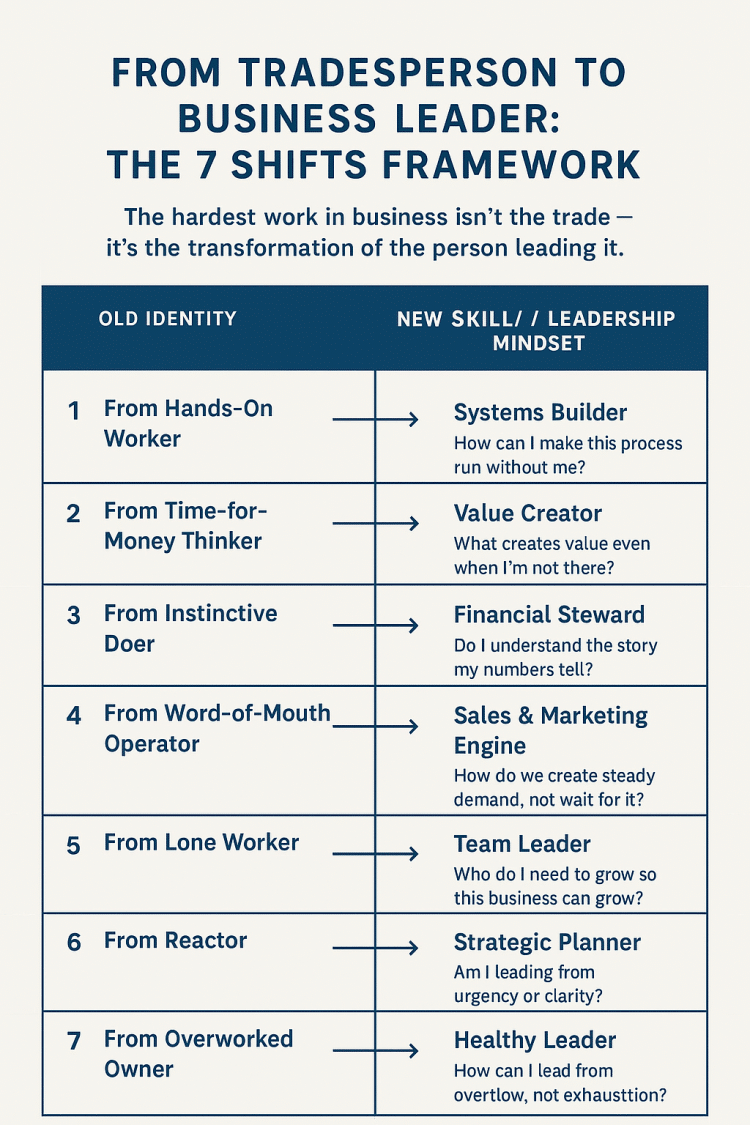
Not all make this transition successfully, as confirmed by the high percentage of businesses that fail in the first five years of existence. Every tradesperson who becomes a successful business leader must make seven shifts in perspective and procedure.
1. Hands-on worker to systems builder.
As a tradesperson, you provide products and services in exchange for the value you receive. In order to scale this activity into a business, a business leader must begin to understand the actual processes that lead to success. He must find effective ways of systematizing these activities so others can be hired, onboarded, and trained to achieve as good and consistent results as he himself has done.
These systems must extend well beyond the scope of the trade itself. They must encompass all aspects of effective business, which include marketing, sales, efficient production, hiring and managing people, and tracking all the activities of the business. Systems must be in place for the oversight and management of profitability and adequate cash flow.
2. From time-for-money thinker to value creator.
As an hourly- or performance-based paid employee, the primary resource you bring is the investment of your time and skills. You are compensated based on your input. Even if you initially just add a few people like this to your business, new challenges begin to emerge almost immediately. Who schedules their work? Who makes sure there is enough new business to keep everyone busy? How do we track our income and expenses to know if we are actually making money?
It’s not uncommon in some stages of business life for employees to make more money than the owner. Here, the entrepreneur must begin to think like a business owner and discover how to actually drive value exponentially through other people. The value created must be greater than the time invested in order to build a successful business.
3. From instinctive doer to financial steward.
Many tradesmen see their value in their ability to do their craft well and more efficiently than their peers. Transitioning from that perspective to being a business leader means thinking in terms of having all assets deployed in revenue-generating activities.
This requires a solid set of numbers. The business leader must accurately track the activities inside the business and then understand the story these numbers tell. Where are we actually thriving? Where are we bleeding? What tools do I have at my disposal to manage these various aspects of business? There comes a critical point at which “working harder and faster” is no longer the best way to generate more value. Working smarter becomes key.
4. From word-of-mouth operator to sales and marketing engine.
Tradespeople often successfully launch a business using the referrals of friends and family to get off to a good start. With some great projects completed, this word-of-mouth referral system can keep one or two people going for quite some time.
In some cases, early industry companies can continue to grow for years with this kind of referral alone. Our family business succeeded for nearly 25 years on this kind of growth strategy. In the world of sheds, however, this method is now largely obsolete except in the case of the smallest startups.
For tradespeople to master the world of marketing and sales requires a significant phase of growth, and many businesses die at this stage of transition. Today’s world of digital marketing, online web and social platforms, and CRMs requires highly disciplined and systemized sales processes to be effective, and many tradespeople struggle to grow adequately to lead these endeavors themselves. (They could hire experts to help, but some entrepreneurs are skeptical of that cost.) Yet this transition is one of the critical developments that must take place to continue being successful.
5. From lone worker to team leader.
In order for a tradesperson to grow and scale his business beyond his own set of skills, he must become an effective leader of a team of people. This requires successfully sharing the vision he has for the business, defining and communicating the values and processes by which he operates, and then inspiring and managing his team to achieve these shared objectives.
Some people find this shift particularly challenging and simply use the “hire and dump” method of adding people. There is little direction given, almost no training and follow-up, and rarely a conversation to review performance and general expectations. Soon—very soon!—chaos ensues.
Becoming a leader and manager of people is a skill that almost anyone can learn. He must want to be a great leader and manager, though, or it will never happen. He must also genuinely care about his people.
6. From reactor to strategic planner.
Many early-stage entrepreneurs lead highly reactive lives. They respond immediately to every phone call, run to keep the “loudest customer happy,” and dash from one urgent task to another. They often hire other people whom they expect to be as invested (often 24 hours a day, seven days a week) in this kind of reactive lifestyle. Again, this becomes a cap to the growth of the business.
As a business leader, you must develop the skills and processes of strategic planning that bring structure to your business. You must create clearly defined roles and processes that allow a few people to deal with the reactionary needs of the business, while others focus on the “deep work” that requires extended focus and time.
These types of structural challenges must be continually updated to accommodate the growth and maturity of the business. Becoming more strategic allows more people to share the vision and join the effort with individual strengths and skills. With good strategy, they have the potential to become a team that achieves much more than merely the sum of its members’ individual skills.
7. From overworked owner to healthy leader.
Few businesses get built—especially by a first-time entrepreneur—without the owner going through a season of “overwork.” This season must be as brief as possible. During this season, many entrepreneurs neglect their personal health, significant relationships, and other aspects of a “life well lived.”
When this pattern of overwork becomes normative, you can guarantee the health of the owner will decline—and with it, the health of the business.
This is where it becomes critical for the owner/founder/leader to “put on his own oxygen mask before helping others.” It takes healthy leaders to grow and lead healthy organizations.
Initially, this can be a painful shift. However, after one makes the shift to a healthier rhythm of work/rest and recovery, the quality of his work and leadership inevitably increases. The added clarity possessed by a healthy leader boosts his confidence, which then facilitates better decision-making and people management.
Listed one after the other on paper, these seven shifts can seem overwhelming. Yet taken one at a time, it’s well worth the investment in your personal growth (reading, reflection, peer advisory groups, coaching, conferences, etc.) to become the kind of person who can effectively lead a business. Many have successfully made these shifts and truly achieved a life they love, and with a bit of care and attention, you can also be one of those. Enjoy the journey!